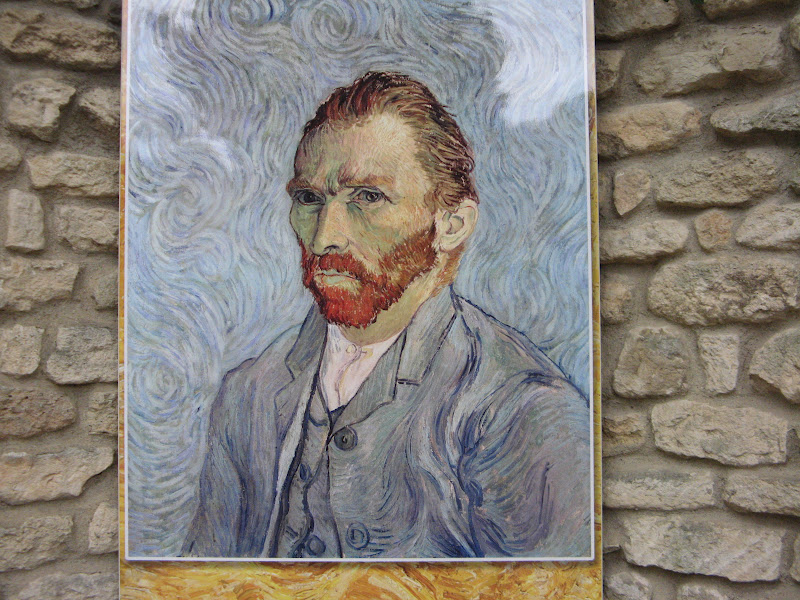
So far we had not done any archaeological remains from Greek/Roman civilisations (aside from Le Pont Julien) so we decided to go to St. Remy de Provence, 2km from which is the archgaeological site of Glanum. We were killing 2 birds with one stone because, just beside Glanum, there is the Monastere St. Paul de Mausole where Van Gogh admitted himself between 1889 and 1890. It was there that Van Gogh completed about 140 paintings, most of which are his most famous today.
On arrival, a quick trip to the Tourist Office for a map and we were all set. We had been very fortunate to get a parking place just outside the tourist office. We were doubly fortunate that the horodateur (where you pay foe parking) was out of order so we parked free - tant mieux for us!
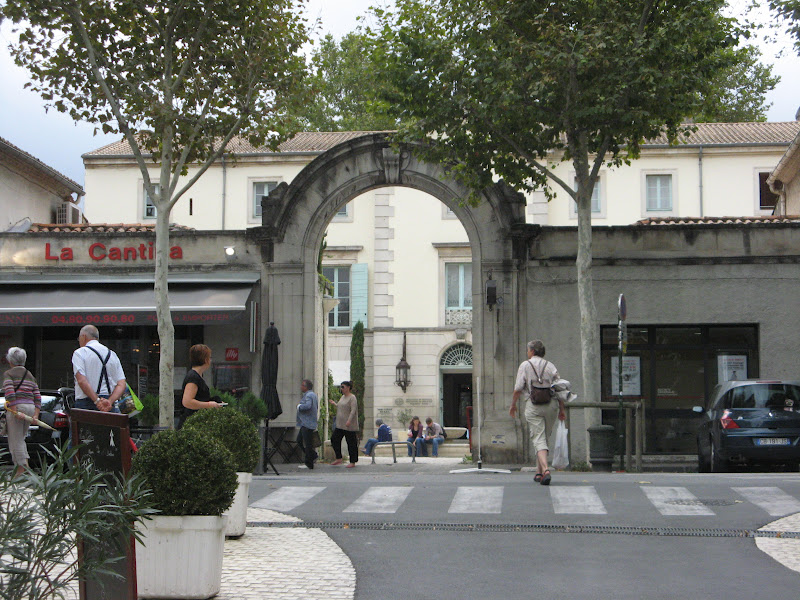
St Remy is in just north?/west? (depends on the book you read and as I have no sense of direction I have no idea!) of the Alpilles range of mountains. It is in the Bouches-du-Rhone department of France. Towards the end of 19th century it began attracting painters, writers and musicians such as the composer Charles Gounod and the artist Vincent van Gogh. We entered the town via the Porte St. Paul which you see here.
 |
| This is the Mairie in Place Pelissier. |
We stopped in Place Pelissier for photos of the Mairie and of the Dolphins Fountain. There are lots of dolphin fountains in Provence.
Musee Estrine, an elegant 18th century private mansion. which is now a contemporary art museum that also houses the "Van Gogh Presence Interpretation Centre" - closed for renovations until autumn 2013!
 |
| Fontaine Nostradamus |
Nostradamus, Michel de Nostredame, was a French apothecary and reputed seer who published collections of prophecies that have become famous worldwide. He was born in December 1503 in St Remy de Provence.
 |
| Old house with a watchtower. |
 |
| Another gate. |
 |
| Musee des Alpilles. |
 |
| Another gate. |
 |
| Hotel des Lubieres, a private mansion that was supposed to have sculptures on almont trees but we couldn't see them! |
 |
| Musee des Alpilles. |
 |
| Hotel de Sade (Renaissance era) where the famous Marquis de Sade lived. |
Today was funfair day in St.Remy de Provence and the place was full of hurdy-gurdies etc. obscuring the facades of what would be attractive churches for example. Even the market was cancelled and we weren't the only disappointed English-speaking tourists! This is a week of celebration and there is something on each day so today funfairs - could have done without that! Yesterday there was bull-fighting like we saw in the Camargue. Could have tolerated that again!
 |
| Front of Collegiale St. Martin. Rebuilt in 1821 in the neo-classical. Inside a fantastic organ which did not photograph well. |
This Gothic style Chapelle Jean de Renaud seems to be attached to the Collegiale St. Martin. It has a 14th century church tower, the only remaing vestige of the medieval church which collapsed in 1818.
 |
| Another gate. |
This is the house in which Nostradamus was born - according to the plaques on the wall.
 |
| A fountain in Place Favier. |
 |
| We noticed this decoration of a tree - modern art according to the shop which is just beside - a shop specialising in Provencal sweets/biscuits where I purchased! |
 |
Happy, having made my purchases - traditional Provencal calissons,
a marzipan , fruit-flavoured delight! |
 |
| The other side of me! |
 |
| Mausoleum of the Julii (30 BC) |
After lunch and a bit more traipsing through St. Remy, we headed out the 2 km to Glanum. First we viewed the Antiques which, from the 16th century, were viewed by learned men and visitors - we were simply visitors, no learning in this area at all! These monumnents, a triumphal arch and a mausoleum, were the only vestiges of Glanum then visible. In the 17th and 18th centuries, an increasing number of ancient objects were discovered in their vicinity.
 |
| Close-ups of the base of the Mausoleum. |
 |
| On top the Julii, happy to wear the toga! |
 |
| The Triumphal Arch (20 AD) |
This Arch of Triumph marked the entrance to Glanum. It and the mausoleum are some of the best-preserved Roman remains in Provence.
 |
| Detail under the arch.. |
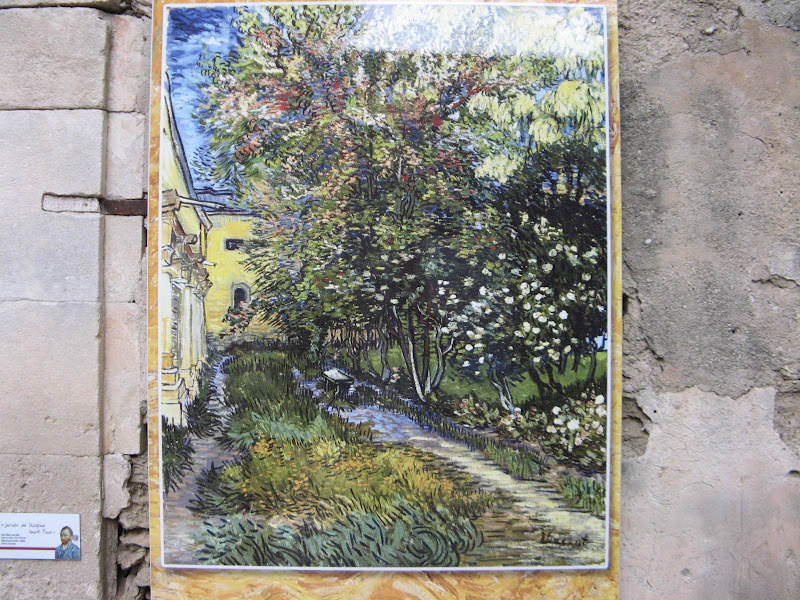
Before going into Glanum, we made our way to the Monastere St. Paul de Mausole where a wing of the Romanesque cloister is occupied by a museum, Centre Culturel et touristique Vincent Van Gogh, which recounts the period during which the painter was confined here. On the avenue up there are several photos of paintings that Van Gogh did in those places.
 |
| The olive trees as they are today. |
 |
| The olive trees as they are today. |
The "Van Gogh Field" offers visitors an opportunity to admire over 20 reproductions of the canvasses at the very place they were created. Saint Paul de Mausole is still a "rest home" for people with psychological/psychiatric problems.
 |
| Sculpture entitled "Stealing Sunflowers" I think. |
 |
| The door of the Chapel at Monastere St. Paul de Mausole. |
 |
| The cloister where the museum is set. |
 |
| The cloister. |
 |
| Van Gogh's bedroom in St. Remy. |
 |
| His room reproduced in the museum |
 |
| Somehow I failed to notice this but Jim took a photo. |
 |
| Statue of St. Joseph in the Chapel. |
While we were wandering through the "Van Gogh Field" we felt large drops of rain and heard an enormous thunderclap and then the downpour. Fortunately the boutigue of the museum was near at hand and there we sheltered for more than half an hour from the torrential rain.
Once the rain cleared we set off up the road for Glanum. From 1921, systematic archaeological digs were carried out on the site which unearthed first the surroundings of the basilica, a vast administrative building with 24 square foundation pillars still visible; the houses in the northern area and the thermal baths. Since 1983, digs and research have once again been under way. Further digs and restoration continue.
 |
| The setting of Glanum - just in the shelter of the Alpilles mountains. |
The first inhabitants settled here in the 6th and 7th centuries B.C. Pottery and coins thrown as offerings into the swallow-hole above the spring indicate that the Gaulish settlement was motivated by religious reasons from its origin. A Celtic God, Glan, together with his benevolent companions, the Glanic Mothers, lived in the waters that were thought to have healing properties and which gave their name to the inhabitants.
Subsequent relations with the Greek world brought wealth to the inhabitants of Glanum, resulting in the extension of the inhabited zone and the construction of buildings in the Hellenistic style in the 2nd and 1st centuries B.C. Then Glanum became a Roman colony in the very early years of Augustus' reign (63 B.C. - 14 A.D.) This resulted in the rapid, profound transformation of the city's monumental architecture.
Finally, unable to resist the Alamannic invasions of 260 A.D., the town was abandoned by its inhabitants in favour of the nearby agglomeration that came into the possession of the Abbey of Saint Remi in Reims in the Merovingian period.
 |
| In the background the rock with two holes which Van Gogh also painted. |
So, an interesting and instructive day all round. And no further lavatorial episodes!